Improving Critical Infrastructure Training Through Interactive Simulation
Executive Summary
Electric utilities and infrastructure operators face increasing challenges in training a new generation of technicians and operators while maintaining high levels of safety and reliability. Traditional classroom and field training methods alone are no longer sufficient to address complex operational environments.
Interactive simulation training platforms provide a scalable and safe approach to workforce development by enabling personnel to practice real-world procedures within immersive digital environments.
Organizations implementing simulation-based training report:
- Improved procedural accuracy
- Reduced safety incidents
- Faster workforce readiness
- Lower long-term training costs
Industry Training Challenges
Workforce Turnover
Many utilities are experiencing workforce transitions as experienced technicians retire. This results in:
- Loss of institutional knowledge
- Increased training requirements for new hires
- Reduced field mentoring capacity
Safety Risks in Field Training
Traditional training often requires exposure to hazardous environments such as:
- Energized substations
- High-voltage transmission lines
- Confined underground infrastructure
Even controlled training scenarios can present significant risks.
Increasing Grid Complexity
Modern grid systems now include:
- Renewable energy integration
- Distributed generation
- Advanced automation systems
Operators must respond to complex scenarios that are difficult to reproduce during traditional training.
Simulation-Based Training Technology
Modern simulation platforms integrate several key technologies:
3D Infrastructure Modeling
Detailed digital environments replicate real-world infrastructure including:
- Substations
- Transmission towers
- Distribution networks
- Control rooms
Interactive Scenario Training
Simulations allow trainees to practice procedures such as:
- Switching operations
- Lockout/tagout safety procedures
- Equipment maintenance
- Emergency response
Virtual Reality Training
VR enables full immersion, improving spatial awareness and procedural memory.
Trainees can physically interact with equipment in realistic environments.
Applications in Electric Utilities
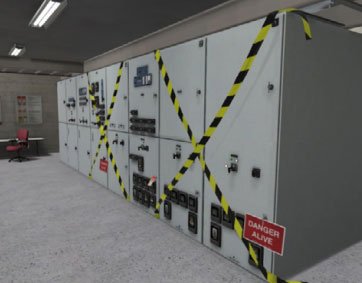
Substation Operations Training
Simulated substations allow operators to practice switching procedures without the risk of arc flash incidents.
Training includes:
- Breaker operation sequences
- Protective relay interactions
- Isolation procedures
Transmission Line Safety
Lineworkers can train in virtual environments before working at height on real towers.
Training scenarios include:
- Fall protection procedures
- Conductor installation
- Hazard identification
Grid Operations Simulation
Control room operators can train using simulated grid conditions.
Research programs supported by the
Electric Power Research Institute have demonstrated that simulation improves decision-making during grid disturbances.
Measurable Benefits
Organizations implementing simulation training report improvements in:
Training Efficiency
- Faster skill development
- Reduced need for repeated field training
Safety Performance
Simulated environments allow workers to experience hazardous situations safely.
This improves hazard recognition and risk awareness.
Operational Reliability
Operators who train with realistic scenarios respond more effectively to system disturbances.
Conclusion
Interactive simulation training represents a major advancement in workforce development for critical infrastructure industries.
Utilities adopting these technologies improve safety, reliability, and workforce readiness while reducing long-term training costs.